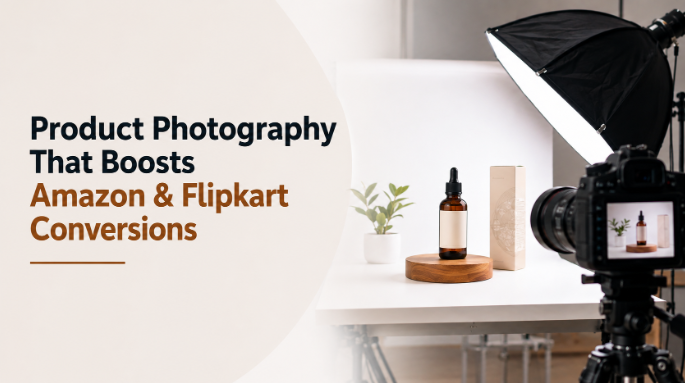
D2C brands spend heavily on ads, influencer partnerships, and platform fees — and then lose the conversion battle at the exact moment it matters most: the product listing page. Buyers scroll fast. Images either stop the scroll or they don’t, and most founders underestimate how much conversion rate rides on this one variable.
Why Product Photography Is a Conversion Lever, Not a Design Expense
Most D2C founders treat product photography as a one-time cost to tick off the launch checklist. That’s the wrong frame entirely.
Marketplace algorithms on Amazon and Flipkart both weigh click-through rate and conversion rate heavily in ranking decisions. Better images don’t just improve sales directly — they improve organic visibility too. A listing with stronger images earns more clicks on the same impressions, signals better relevance to the algorithm, and compounds ranking gains over time.
That means investing in professional Amazon product photography in Udaipur isn’t a creative expense — it’s a performance marketing decision. You’re making your existing ad spend work harder, not just adding a line item to the budget.
What Separates Amazon-Ready Images From Amateur Shots
There’s a difference between product photos that look nice and product photos that convert. Here’s where most amateur or DIY shoots fall short:
- Platform compliance
Amazon and Flipkart enforce minimum resolution, pure white background requirements for the primary image (RGB 255, 255, 255 — not off-white, not grey), and specific aspect ratios. Non-compliant images get flagged, suppressed, or rejected outright. This is one of the most common and entirely avoidable delays new sellers run into. - Lighting that accurately represents colour and texture
Poor lighting misrepresents product colour, flattens texture, and creates unnatural colour casts that make products look cheap — or worse, look different from what arrives in the customer’s hands. Returns driven by colour mismatch are directly traceable to bad photography, not product quality. - A complete image set, not just a hero shot
Amazon allows up to 9 images per listing — and you should use every slot. Buyers scroll through multiple images before deciding. Missing angle shots, scale references, or in-use context images leaves buyer questions unanswered. Unanswered questions become abandoned carts. - Lifestyle shots that build purchase intent
Beyond the compliant white-background hero image, lifestyle shots showing the product in real use build emotional connection. Buyers don’t just see the product — they see themselves using it. For considered-purchase categories especially, this measurably improves conversion.
What a Professional Studio Session Actually Delivers
A well-run studio shoot produces a complete image package in a single session — not a handful of hero shots that leave you scrambling for the rest.
A proper session should deliver:
- Compliant white-background hero image
- Multiple angle shots
- Detail and texture close-ups
- Scale-reference images
- Lifestyle in-context shots
- Infographic-ready images with space for overlay text
Everything the listing needs, without multiple reshoot rounds eating into your launch timeline.
Professional e-commerce product photography in Udaipur studios that specialize in marketplace photography understand both the creative and the compliance sides of this. That combination — creative quality plus platform knowledge — is what separates a studio that produces beautiful images from one that produces images that actually sell.
The Data Behind the Investment
Brands that upgrade from smartphone photography to professional studio images typically see meaningful lifts in both click-through rate and conversion rate on the same traffic.
According to research by Shopify, products with professional photography convert up to 30% better than those with amateur images. On Amazon specifically, listings with 7+ high-quality images consistently outperform those with 3 or fewer — not marginally, but significantly enough that the photography investment pays for itself directly through the same ad spend working harder.
This matters more as competition grows. As more D2C brands enter Amazon and Flipkart, the gap between amateur and professional product imagery has become one of the clearest conversion differentiators on the platform. Listings that looked acceptable two years ago now look visibly weaker beside competitors who’ve invested in proper studio photography.
A Practical Checklist Before Your Next Product Launch
If you’re planning a new listing or refreshing existing ones, run through this before booking your shoot:
- Confirm the studio understands current Amazon and Flipkart image compliance rules — not last year’s guidelines
- Request a full image set in one session: hero, detail, scale, lifestyle, and infographic-ready
- Ask to see comparable work for your product category before committing
- Factor photography timelines into your launch schedule — don’t leave it for the final week when everything else is already running late
- Audit your existing listings against current platform standards before your next ad push
The Bottom Line
Your product listing page is where every rupee of ad spend lands. Weak images at that moment mean weak returns on everything that came before — the product development, the inventory investment, the marketing budget.
Professional product photography isn’t the last thing to sort out. For D2C brands serious about marketplace performance, it’s one of the first.
Information Provided By
Looking for platform-ready product images that actually convert? MN Photography is a premium photography and videography studio based in Udaipur, Rajasthan, specializing in e-commerce product photography for Amazon, Flipkart, Myntra, Meesho, and Shopify. Trusted by 500+ brands across India, the studio delivers compliant, high-quality image sets with in-house editing and a fast 48–72-hour turnaround — so your listings go live without delays. From white-background hero shots to lifestyle and infographic-ready images, every session is built around what marketplace algorithms and buyers actually respond to.